Chronicling the Promises and Pitfalls of Education Reform in Egypt
by Tom Hanlon / Dec 10, 2025
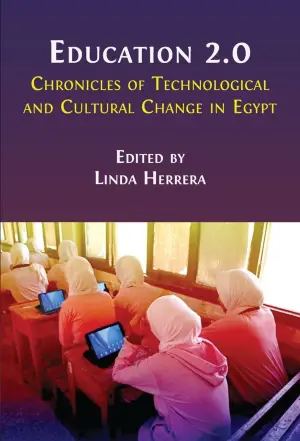
The cover of Linda Herrera’s recently-released book perfectly depicts the impetus and motivation behind this multi-year, complex project.
On the cover of Education 2.0: Chronicles of Technological and Cultural Change in Egypt, a row of Egyptian teenage girls in uniforms sit at wooden desks with tablets opened in front of them. Light shines from the screens of the tablets in the old classroom with its painted-over windows.
The education system in Egypt had long been in decline due to a lack of resources, overcrowding, teacher shortages, and an outdated curriculum. Add to that Egypt’s learning crises as represented by low global education rankings—with many students entering fourth grade without being able to read, Herrera says. It was clear that an overhaul to the national education system was needed.
A “New Republic”
Three years after the Egyptian revolution of 2011, the new government of El-Sisi “set out to build a ‘new republic’ by overhauling many sectors of society, including health, tourism, urban planning, and education,” says Herrera, Professor and Director of Graduate Studies in the Department of Education Policy, Organization & Leadership in the College of Education.
That included, she says, digitally connecting the entire country through fiber cables and making the Egyptian Knowledge Bank, the country’s largest ever digital knowledge project with over 120 databases, freely available to all students and citizens in the country.
“Education 2.0 represented a dream to build a state-of-the-art education system for all of Egypt. The dream didn’t quite get realized due to difficult political-economic and material conditions, though inroads were definitely made,” Herrera says.
Former University of Illinois Urbana-Champaign engineering professor Tarek Shawki spearheaded 2.0 in his role as Minister of Education and Technical Education in Egypt from 2017 to 2022.
Education 2.0 aimed to “transform the culture of learning to respond to a fast-changing world brought about by the Fourth Industrial Revolution,” Herrera says. “It was grounded in skills-based and multidisciplinary approaches and fully integrated digital tools, platforms, and competencies. The reform included curriculum redesign in the primary stage, digital transformation across the sector, and professional development on a new set of standards. As a ‘global’ oriented reform, it also aligned with the United Nation’s Sustainable Development Goal 4 on education and the Africa Agenda 2063.”
Chronicling the Work
Which brings us to Education 2.0: Chronicles of Technological and Cultural Change in Egypt, a 500-plus page book that offers a written history of 2.0, the people involved in it, and the ideas that informed it. The book is organized in two parts: “Oral Histories of Education Policy Innovation and Change” and “Teacher and Student Perspectives.” Education 2.0, published by Open Book Publishers, is an open-access resource, freely downloadable from the publisher’s website.
“It was important for me to ensure this book was open access and not behind any paywall,” Herrera says. “This book documents a national reform, and I worked on it in the spirit of a public scholarly service.”
The book, she adds, can be downloaded as one complete file or chapter by chapter. She doesn’t expect a reader to read from beginning to end but to choose chapters based on what topics are most important to them, whether to understand new approaches to teaching the Arabic language or getting a glimpse into what it’s like for a minister to be in the political arena.
In what can only be termed a massive labor of love, Herrera edited the 29-chapter book (she authored or coauthored 22 of its chapters). The book was not even on her radar when she received funding in 2019 for a secondment to move to Egypt for three years to establish the Education 2.0 Research and Documentation Project. The secondment was cut short due to the pandemic, and in 2020, Herrera returned to the University of Illinois, where she continued her work on the project long distance and part-time, with occasional trips back to Egypt.
Only after she returned to the States did she conceptualize the book that would include interviews and research chapters.
“The process of education reform not only in Egypt but generally, is kind of a black box,” Herrera explains. “You might get a policy document or a World Bank report, but it’s hard to know where these ideas for change are coming from, what is happening behind the scenes, and what people involved think they are doing. That’s where oral history comes in.”
Creating an Oral History
Herrera and her team set about the arduous task of creating an oral history archive of the reform. The original idea was to build an extensive oral history library of Education 2.0 with testimonies from throughout the state, society, and partners from international organizations and the private sector. That vision was cut short due to COVID.
The book captures a modest subset of the original idea with chapters, for instance, on the minister and his advisors, textbook producers, people managing the digital infrastructure and the ministry’s television channels, and students and teachers at the receiving end of the reforms. Part of Herrera’s motivation was to make visible people “who are doing really important work behind-the-scenes, many of whom are brilliant women. I wanted to make sure they get their rightful place in the historical record,” Herrera says.
The people from the “bottom-up” —the students, parents, teachers, and principals—often had a very different understanding of the reforms. “They were not always accepting the reforms in the ways that were intended from the top and often created alternative practices. Culture change is a highly unpredictable undertaking, and the research tries to capture just some of directions of change from the grassroots,” Herrera notes.
Positives of Education 2.0
Even with all the challenges, Herrera says that much good came out of Education 2.0. “The work done in building the infrastructure and upgrading schools to make them compatible with digital resources provided new learning opportunities ,” she says. For instance, analytics on usage of the Egyptian Knowledge Bank showed an especially high rate of usage from students in Upper Egypt, a region with high rates of poverty, agriculture, and unemployment. “It would be fascinating to better understand how students were using the digital resources and if they were contributing to new opportunities and ways of learning,” she says. “We need to better understand if and how the digitalization transformation of the education sector has had an equalizing effect, and how it might be exacerbating inequality.”
Another potential positive coming out of Education 2.0 is the recently elevated reading scores in the rankings. “There’s not good research on this yet to see if there are clear correlations between the reform and better reading scores, but it’s quite likely that the 2.0 initiatives had something to do with that.”
Additional Resources
In addition to the book, Herrera has identified other ways of making available the documentation she collected about the 2.0 reforms. She developed an Education 2.0 website with materials in English and Arabic. It houses all the new digital textbooks and Teacher’s Guides for K-6, the new curricula frameworks, the key policy documents that underpin the reform, and a photo gallery. She has donated a large collection of the physical books to the University of Illinois library. The project’s Youtube channel has 73 videos about Education 2.0, including 23 original oral history highlight videos that Herrera produced.
“I wanted to leave a robust record behind for others to benefit and learn from,” she says of her digital efforts.
An additional resource that Herrera is building is a Wikimedia project in which she is slowly uploading and sourcing a few hundred images shared with her from the Minister and Ministry of Education partners from the first five years of the reforms.
“It’s a work in progress,” she smiles. “It just keep going.”
As have been all her efforts since she began this massive, multi-pronged project in 2018.
“A Beautiful Vision and Idea”
“Education 2.0 was a beautiful vision and idea,” Herrera says. “It was idealistic, though often indifferent to the realities on the ground. To really make the kind of change that it was intending, you need a lot more resources, public buy-in, understanding of what people want at the grassroots, and long-term political support. A difficult combination, I know.”
Herrera feels honored to have been given the trust to document this historic experiment. “I was the only non-Egyptian in the project with relatively free reign among the minister’s associates,” she says. “It was pretty unique to have an educational researcher on board documenting an historic reform in the tradition of the chroniclers of the past. I doubt this will happen again any time soon. To have the access to people as they were working to build up the Egypt’s education system in real time, to have them give me hours of their time as they were constantly ‘putting out fires,’ was humbling and came with responsibilities.
“With all this amazing access, I felt the obligation to do my best to share the primary source materials and research to the greatest extent possible. You never know where it will lead.”
Related News
Sharing the Vision: Documenting Egypt’s Education 2.0 Reform
