Popcorn Pedagogy Reaching New Ears
by Paige Walk, Office of Communications / May 19, 2026
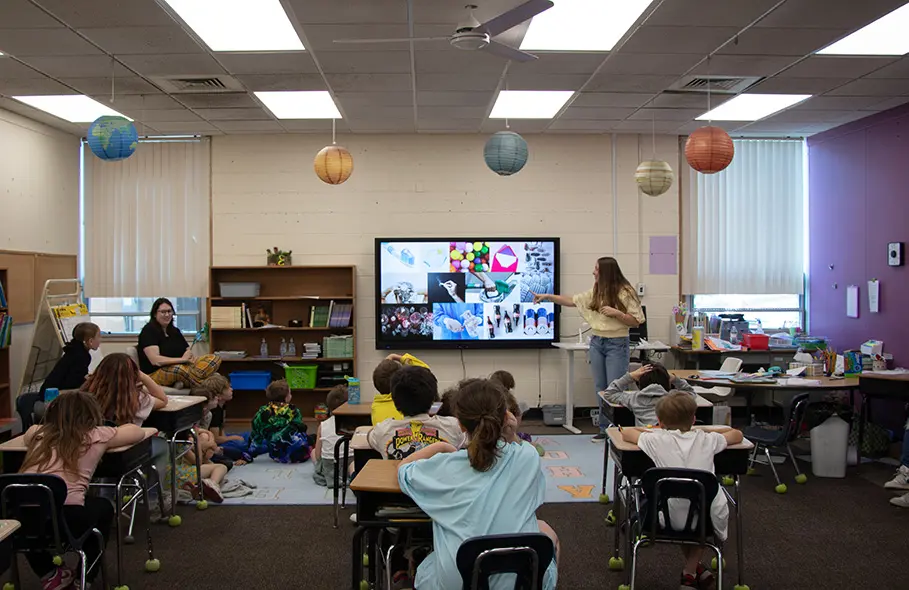
"As an education major, I never thought I would know so much about corn,” says sophomore Hannah Haas.
Haas, a student in the College of Education, is part of a unique project partnership between the College of Education and the College of Agricultural, Consumer and Environmental Sciences (ACES). With funding from a USDA grant, this collaboration brings together future educators and agricultural researchers to develop an engaging, standards-based curriculum for K–12 students using popcorn.
The initiative is led by Professor Anthony Studer, popcorn breeder and an associate professor in the Department of Crop Sciences, whose work focuses on plant genetics. Studer has always been committed to connecting younger students with agriculture and exposing them to potential careers in the field. Building on previous outreach efforts with high schools across the state of Illinois, he started having conversations with colleagues in the College of Education to involve undergraduates in developing a popcorn-based curriculum for younger, elementary school students.
The initiative, called PROCESS, stands for Popcorn-Related Outreach Curriculum and Experiences for Student Success.
“I didn’t really know what it was,” Hannah says. “But I had been looking for an on-campus job, especially a research position.
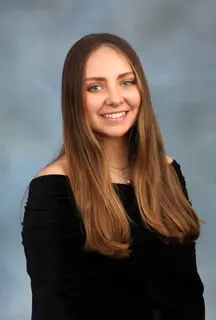 Haas is currently pursuing a degree in Learning and Education Studies, along with Middle Grades English, and a minor in Global Studies with a focus on English as a Second Language. After seeing a collegewide email about the opportunity, she decided to apply. Haas didn’t initially see herself as a natural fit for the role.
“I didn’t think I was qualified because I don’t have a background in agriculture,” she says. “I remember being very frank with them, ‘I don’t know that much about corn.’”
For Studer, that was exactly the point.
“When we’re looking for a position like that, we don’t need someone who knows more about corn—we’ve kind of got corn covered,” he says. “We’re interested in how you teach about that to a broader audience, how you package it, and how you map that onto learning standards.”
This perspective highlights what makes hybrid collaborations so valuable. Rather than duplicating expertise, they bring together different skill sets to create something neither field could accomplish alone.
The curriculum that Haas developed has two primary goals: introducing students to the genetics of corn and helping them understand why corn is important. The added challenge? Making those lessons engaging and accessible for young learners.
“For the first month or two, it was going into the lab, learning about corn, looking at the lessons that exist, and taking notes,” Haas says. “I wasn’t expecting that I would make my own lessons from scratch. But it ended up being my own creation, which is really exciting.”
Marie Shaffer, senior research specialist in the Studer Lab, oversees undergraduate involvement and helps connect the research to educational outreach. Working alongside Haas, they translated complex scientific concepts into hands-on classroom activities for elementary students.
This May, Haas, Shaffer, and Ag in the Classroom educator Julie Adcock visited Thomasboro Grade School in Thomasboro, Illinois. Haas was able to debut her newest lesson, along with a fun activity designed to help students understand starch content differences between types of corn. Bouncing between classes and age groups in the K-8 school, the team reflected on each lesson and adapted on the fly for the next classroom.
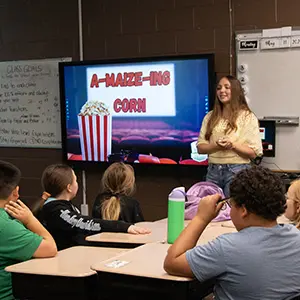 Throughout this experience, Haas says she’s gained practical skills that extend far beyond the classroom. Translating complex material into age-appropriate lessons, collaborating across disciplines, and adapting content and delivery for different learners are all critical tools for future educators.
Shaffer says that initiatives like PROCESS challenge the traditional siloed model of higher education.
“I think it’s helping us create opportunities for students to understand the importance of working together and being able to communicate across different industries,” Shaffer says. “These programs help students improve their communication, adaptability, and creative problem-solving.”
Studer agrees that this kind of collaboration is essential—especially at the undergraduate level. “Not everybody can be an expert in everything,” he says. “But we’re sitting on a campus with world-renowned experts in almost every field. It’s that collaborative nature that’s really prominent here at Illinois, and it’s something we should continue to build on.
For Haas, this experience has broadened her perspective on both education and collaboration. “It’s been really rewarding for me, especially expanding outside the College of Education,” she says. “It’s given me a glimpse into what other faculty and students are studying and developing at Illinois.”
As higher education prepares students to address increasingly complex, interdisciplinary challenges like food security, programs like this show how meaningful learning occurs at the intersection of fields—even cornfields.
For more about PROCESS, visit https://aces.illinois.edu/news/snack-science-innovative-grant-brings-popcorn-classroom