Free Mental Health Clinic Now Open in Champaign
by Sarah Frances Holder, Smile Politely / Feb 3, 2026
Therapy is often inaccessible due to barriers like prohibitively high cost, issues with health insurance, or lack of available therapists.
However, the folks at the University of Illinois College of Education hope to change that. They recently launched the Healing, Training, and Research Clinic—a completely free mental health service that matches members of the community with graduate students currently training to become mental health clinicians. I spoke to Dr. Lisa Kinderman and Dr. Lydia Khuri to learn more about the clinic and what makes it different from other mental health services in the area.
This article has been edited for length and clarity.
Smile Politely: How did the clinic come to be? What made you decide to establish it?
Dr. Lisa Kinderman & Dr. Lydia Khuri: It was a combination of practical needs and bigger aspirations. Our M.S. in Mental Health Counseling program has been growing, and we needed to find quality placements where our students could gain hands-on clinical experience.
Our program was developed during the COVID-19 pandemic in part as a direct response to the shortage of mental health professionals in our state…Initially, we thought we’d focus on serving students, but after talking with mental health leaders on campus, we learned that University of Illinois students, faculty, and staff already have good access to resources. That’s when we shifted our focus to the broader community.
We see launching the clinic as a win-win for everyone involved. Our students get to apply what they’re learning about psychological science and culturally responsive practice in real-world settings, and community members get access to quality, free counseling.
SP: What kind of services does the clinic offer?
Dr. Kinderman & Dr. Khuri: We offer two main services. The first is individual counseling—weekly, in-person sessions where clients work one-on-one with a student clinician. Right now, we’re focused on short-term counseling, which typically is 3-12 sessions offered January through May.
The second service is psychoeducational workshops. We develop these in partnership with local groups, organizations, and businesses based on what they need. We’re really excited about offering workshops on various health and wellness topics such as healthy communication strategies, working with emotions, and finding joy in everyday life.
SP: What kinds of issues or concerns do you work with?
Dr. Kinderman & Dr. Khuri: We work with a wide range of concerns that adults face—things like stress and anxiety, relationship challenges, life transitions, grief, depression, work-related issues, and identity exploration.
Because we’re a short-term training clinic, we’re not equipped for concerns that require crisis intervention, intensive treatment, or longer-term specialized care…If someone isn’t sure whether their concern is a “good fit,” we encourage them to reach out anyway. During that initial phone conversation, we can talk through what they’re experiencing and help them figure out whether our clinic or another resource might be best for them.
SP: What can someone expect when they reach out?
Dr. Kinderman & Dr. Khuri: After filling out the inquiry form on our website, one of our clinic staff will call to set up a brief phone screening—a confidential 20-minute conversation. During this call, we’ll ask some questions to get a sense for what someone is looking for and whether our short-term training clinic is a good match for their needs.
SP: Who will I be working with if I come to the clinic?
Dr. Kinderman & Dr. Khuri: Clients will be working with graduate students in our Counseling Psychology master’s program. These students come from diverse backgrounds and are immersed in both the science and practice of counseling…It’s important to know is that our student clinicians are closely supervised by our clinical faculty, who are all licensed mental health providers. This means every client benefits from both the enthusiasm and fresh perspective of a developing clinician and the expertise of seasoned professionals providing mentoring and support behind the scenes.
SP: What can someone expect from their first session?
Dr. Kinderman & Dr. Khuri: The first session is about getting to know each other and understanding what brings someone in. The clinician will ask questions to learn about what’s been going on, what the person is hoping to work on, and what they’d like to be different in their life. Together, they’ll start identifying some goals for the work. It’s a collaborative process from day one—we believe clients are the experts on their own lives, and our job is to walk alongside them.
SP: How long are sessions, and how does scheduling work?
Dr. Kinderman & Dr. Khuri: Sessions are typically 50 minutes and happen once a week. We work with clients to find a consistent time that fits their schedule. Consistency really helps build momentum in the work.
SP: What happens after the short-term sessions are up?
Dr. Kinderman & Dr. Khuri: As we approach the end of our time together, the clinician and client will work on wrapping up the work they’ve done and discussing next steps. If someone feels they’d benefit from continued counseling, we’ll help connect them with ongoing resources in the community.
SP: What need does this clinic fill within the community?
Dr. Kinderman & Dr. Khuri: Counseling is what we call a “tertiary intervention”—it’s there for people who’ve identified an emotional or psychological challenge they’d like help working through in a confidential, one-on-one, and completely non-judgmental setting. Because our services are free, we’re hoping to reach people who’ve been thinking about counseling but might not have been able to afford it.
SP: How is this clinic different from other mental health services in the area?
Dr. Kinderman & Dr. Khuri: First off, it’s free. Second, we’re grounded in a multicultural framework, which reflects our entire academic program, not just the clinical work.
Third, we have a research component that’s unique. We know from research that therapy works, but we’re still learning about what exactly makes it work. One way we do this is by tracking therapy progress throughout treatment. Our student clinicians use this feedback in real-time, collaboratively with their clients, to guide the work. This kind of feedback loop tends to lead to better outcomes for clients and helps us continually improve our training and services.
SP: Do patients still need insurance to be seen?
Dr. Kinderman & Dr. Khuri: Nope! No insurance needed. The service is completely free.
SP: What does a multicultural approach mean in the context of therapy?
Dr. Kinderman & Dr. Khuri: Our students learn to pay attention to the sociocultural factors that shape clients’ experiences and worldviews—things like culture, identity, background, and life circumstances. They also learn to reflect on their own sociocultural identities and how these factors show up in the therapy relationship itself.
This kind of learning is ongoing—even for us faculty. We don’t claim to have all the answers. Instead, we’re committed to staying curious, being open to hearing our clients’ lived experiences, engaging in self-reflection that serves our clients’ healing, and advocating on their behalf when appropriate.
SP: Is there anything else you’d like residents to know about the new clinic?
Dr. Kinderman & Dr. Khuri: A few things! The College of Education has been incredibly supportive in helping us establish the clinic. We currently operate from January to May but hope to expand to services year-round in the future. As we build the clinic, we hope to be able to offer different types of services to reach more people who would like access to counseling; for example, we might be able to offer virtual appointments.
We’re also thrilled to be partnering with Dr. Nia Mitchell, a fellow faculty member who’ll be leading a culturally responsive evaluation of our clinic. This will help us understand our impact from multiple angles—on the community, on clients, on the college, on faculty, and on our student trainees.
SP: Where is the Clinic Located?
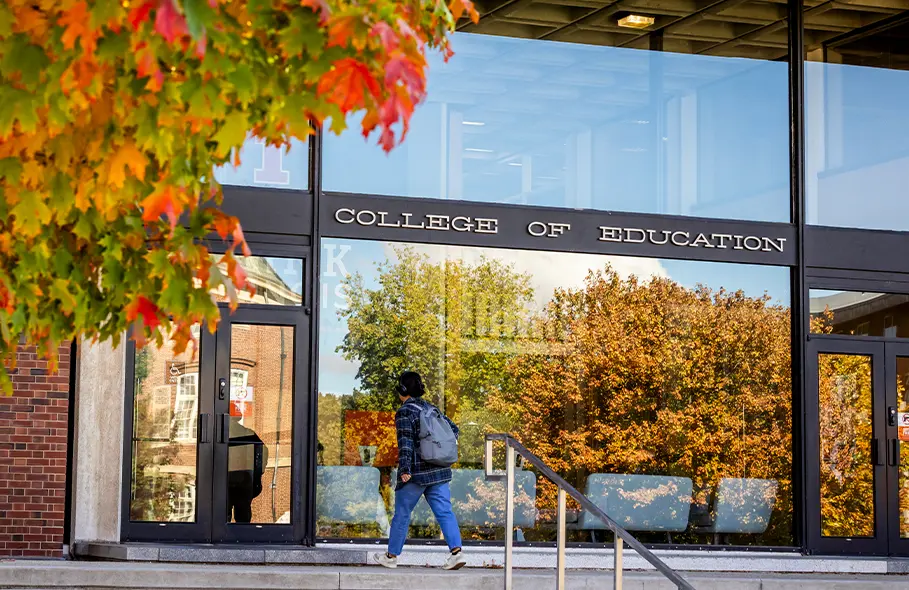
Dr. Kinderman & Dr. Khuri: We’re located in the College of Education. There’s street parking available in the surrounding area, and there’s also a nearby parking deck.
This article was originally published in Smile Politely.