IWERC Joins the College of Education
by Ashley Lawrence / Oct 21, 2026
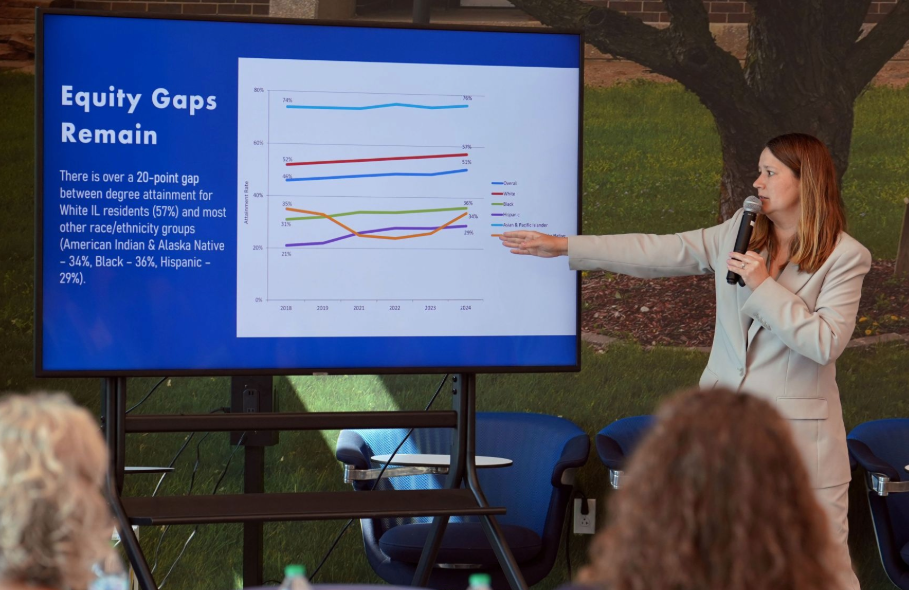
For Meg Bates, the value of education research is undeniable when a school leader learns of a finding and immediately recognizes a new possibility.
This happened as Illinois school districts gathered to hear about research on the state’s investment in addressing teacher vacancies during a recent event. The Illinois Workforce and Education Research Collaborative (IWERC) had examined how various districts were using their funding and shared what it learned. Listening to colleagues describe their approaches and successes, some district leaders realized they could put the resources to work in ways they had not considered.
Bates, IWERC’s inaugural director, says these exchanges capture the initiative’s purpose: to help Illinois educators and policymakers turn evidence into decisions that ultimately improve the state’s education and workforce systems.
Official earlier this year, IWERC’s transition from the Discovery Partners Institute to the College of Education at the University of Illinois Urbana-Champaign brings that statewide mission into closer alignment with faculty, research centers and projects addressing many of the same challenges. The move formalizes relationships that have developed organically and creates opportunities to connect the College’s expertise with IWERC’s partnerships across Illinois.
“I feel like there have already been several natural synergies happening between the College of Education’s research and IWERC’s mission. There’s a lot of shared interest in similar issues, because the issues that we're studying are usually ones of great importance,” says Bates. “This move opens up galaxies of opportunity for us to collaborate more closely and work on shared projects.”
A Natural Alignment and a Homecoming
Launched in 2020 within the Discovery Partners Institute, then an initiative of the University of Illinois System and based in Chicago, IWERC began with a broad charge: conduct applied research on Illinois education, from early childhood through workforce development. Bates was appointed its first director after serving more than a decade at the University of Chicago, where she worked with schools and districts on the structures needed to sustain strong STEM instruction.
Her commitment to community-engaged, partnered research took root at Illinois, where she earned her doctorate in Educational Psychology in 2009. Bates spent time as a graduate student in K-12 classrooms, studying instruction and working with teachers on professional learning efforts.
She learned that useful research requires a reciprocal relationship. That teachers and school leaders bring knowledge of classrooms and communities that researchers need to understand. And improving systems begins with taking this expertise seriously.
Robb Lindgren, the College’s associate dean for research, worked closely with Bates on the proposal to transition IWERC and its 10 research scientists to the College of Education. He sees the understanding that Bates, as a graduate student, gained from working alongside educators as a benefit now extending to dozens more Education at Illinois students.
“IWERC has relationships with schools, agencies and advocates that will give our student researchers more opportunities for authentic experience working with statewide partners for the public good,” says Lindgren.
However, while IWERC’s realignment is a homecoming of sorts, its research team will remain based in the Chicagoland area where Bates says many statewide policy conversations and practitioner gatherings take place. IWERC’s presence at these meetings helps the team be part of discussions where research can inform decisions.
“Through adding IWERC and its mission to our research ecosystem, I believe we are significantly enhancing the capacity of our faculty researchers to impact state policy,” Lindgren says.
Listening Across the Education-to-Workforce Pipeline
IWERC organizes its research across four connected sectors: early childhood, K–12 education, postsecondary education, and workforce development. Its mission is to work with community partners throughout Illinois to investigate pressing issues and develop solutions across the education-to-workforce pipeline.
The scope is broad because the experiences are connected: access to early childhood services, a school’s ability to retain teachers, a student’s college choices, and the availability of rewarding work all shape educational and economic opportunity. To understand those experiences, IWERC works closely with the state agencies responsible for each sector. Bates points to partnerships with the Illinois Department of Early Childhood, the Illinois State Board of Education, higher education agencies, and workforce agencies.
These partnerships help the IWERC team use state data to answer practical questions. But the questions themselves often begin with people working in the field: teachers, school leaders, unions, professional associations, intermediary organizations and advocates.
“Listening is a number one priority for us,” Bates says.
Starting With What Illinois Needs to Know
IWERC’s priorities also continue to evolve through its advisory groups, project partnerships, and emerging policy needs.
Some of the most consequential questions for IWERC sound straightforward: What is happening across the state? Which communities have access to certain opportunities? Are services reaching the children and families they’re intended for? Bates calls these “state of the state” questions. Stakeholders may want to know which districts are successfully offering precollege coursework to diverse students or how young children move through early childhood programs and intervention services.
Other questions begin with a widely held impression. Educators or policymakers may suspect a pattern exists but lack the evidence to confirm it. IWERC can test the assumptions, either supporting what partners believe or revealing a different picture.
Examples of topics that IWERC has researched, evaluated and reported on include:
- The current landscape (characteristics) of Illinois’ rural school districts and their science and mathematics teacher workforce.
- Better understanding Illinois high school seniors’ postsecondary choices, pandemic effects included.
- The connection between higher education and economic mobility in Illinois, and where different education and workforce pathways lead.
Bates sees this statewide descriptive work as particularly complementary to the College’s research strengths. A clearer picture of conditions can help faculty identify where to investigate further, including questions about why a pattern occurs or which approaches might change it.
The connection also works in the other direction. As College investigators produce findings, IWERC can help bring relevant evidence to the state agencies and practitioner groups positioned to use it. Bates says this collaboration is central to the new alignment: a stronger connection between understanding Illinois’ educational landscape and improving it.
“Sometimes we’re creating research. Sometimes we’re drawing on research that other really smart people have done,” says Bates. “But IWERC is part of that direct pipeline of research to impact every day.”
Related News

IWERC: College Still Pays Off, but Wage Gaps Persist in Illinois
