Announcing the 2026-27 Public Engagement Fellows
by Office of Communications / Aug 10, 2026
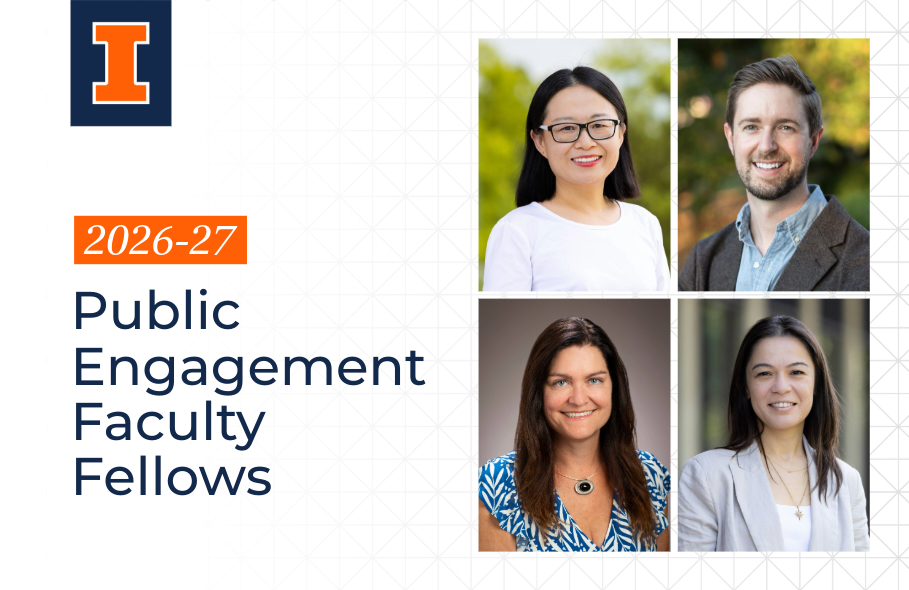
Now in its fifth year, this program enhances ongoing community engagement efforts of the College of Education. Fellows' work strengthens campus-community ties and gives educational partners more opportunities to participate in campus activities.
Public Engagement Fellows receive up to $6,500 to help fund their community-engaged research or teaching project.
The four faculty selected as 2026-27 fellows will work closely with educational partners to develop work that addresses social and civic issues and aligns with community priorities.
“With the addition of this year’s cohort, the College has hosted 22 public engagement faculty fellows since the program began in 2022,” says Emily Stone, Director of Public Engagement for the College of Education.
“These projects help the College build meaningful relationships within communities and better meet the needs of local school and community partners," says Stone. "This particular group of fellows really showcases the broad geographic reach of our partnerships in Illinois, with projects spanning Champaign-Urbana to Rantoul and Chicago.”
Lin Chen, Associate Professor, Educational Psychology
Chen’s project partners with the University of Illinois Police Training Institute (PTI) to investigate how recruits learn from texts, where effective reading is essential for mastering technical content and succeeding on high-stakes certification exams. Using eye tracking and comprehension assessments, the project will identify barriers to reading comprehension, provide recruits with individualized feedback to support their learning, and help PTI improve instructional practices through evidence-based recommendations.
“Reading is fundamental to learning, especially in professions where accurate understanding can have real-world consequences," says Chen. "I hope this project demonstrates how cognitive science can be translated into practical solutions that help people learn more effectively from texts and strengthen evidence-based training.”
Devon Hedrick-Shaw, Assistant Professor, Curriculum & Instruction
“By partnering together, the goal is to better understand connections between bilingual teacher learning and teacher retention in Rantoul," says Hedrick-Shaw. "This work could inform district policies as well as future collaborative opportunities between the College of Education and local school districts around bilingual teacher recruitment and retention.”
Melissa Morgan, Professor, Educational Psychology
Morgan’s project will collaborate with Chicago-area promotoras, or health workers and grassroots leaders within Hispanic and Latino communities, who have been working with immigrants to address the changing needs of the immigrant community in recent years. She will collaboratively develop a training geared towards their specific wellness needs to help them conduct their work. This project is part of a larger, ongoing Santa Barbara Wellness Project, designed by Morgan and others, which has trained over 500 community members in general wellness skills in the past fifteen years.
“Our goal is to help the Chicagoland promotoras utilize much-needed wellness skills to better conduct their important work with immigrants,” says Morgan. “We want to collaboratively design a facet of our overall programming that is geared specifically towards them and the work they do.”
Miray Tekkumru-Kisa, Associate Professor, Curriculum & Instruction
Tekkumru-Kisa will partner with a science instructional support leader for Network 14 in Chicago Public Schools. Their work is organized as a research-practice partnership. It will involve collaboratively designing and implementing a professional learning program to support teachers in facilitating productive discourse that is responsive to students’ ideas and experiences as assets in science classrooms.
“I believe in the power of sustained partnerships between universities and school districts to address real challenges in teaching and learning," says Tekkumru-Kisa. By working alongside partners in Network 14 to support responsive classroom talk in science, we hope to help teachers create rich learning opportunities that build on the strengths, experiences, and ideas students bring to the classroom every day and position students’ voices as a central resource for sensemaking and engagement in science learning.”