From Taking the Course to Teaching It
by Tom Hanlon / Jul 14, 2026
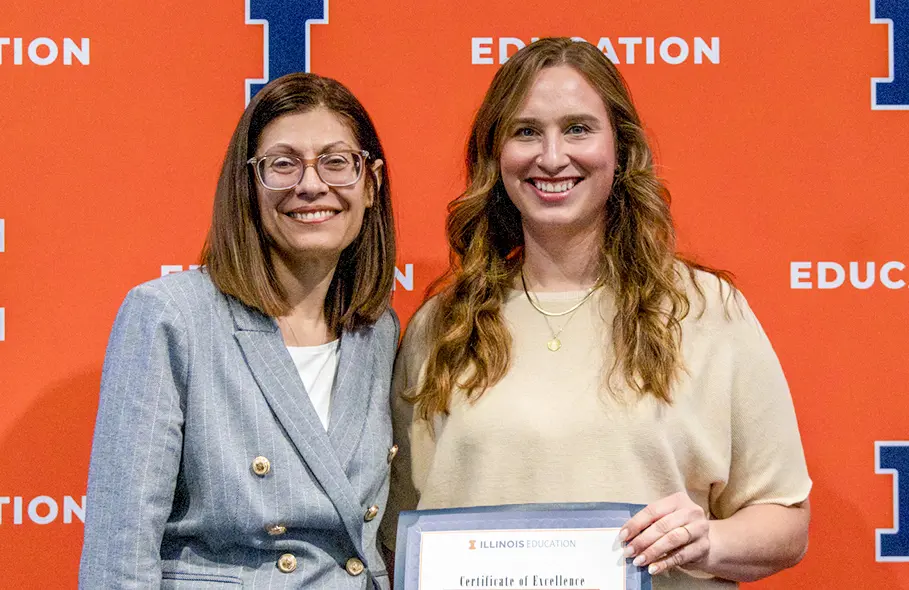
Katie Davenport with Dean Chrystalla Mouza receiving the Outstanding Teaching Assistant Award at the College's Awards Ceremony in May 2026
Katie Davenport, once an undergraduate student in Karla Möller’s Principles in Teaching Literature to Children and Youth course, is now a doctoral student under Möller’s academic advisement—and teaching the same course they met in.
Katie Davenport loves children’s literature. Want proof?
Well, she once maxed out her library card at 200 titles.
When she was Karla Möller’s undergraduate student in the spring of 2011, she emailed Möller frequently with ideas and questions about what she was learning in the course.
Suffice it to say, Davenport brings passion and energy to whatever she is doing.
“That was my favorite class,” Davenport says of Möller’s Principles in Teaching Literature to Children and Youth course. “I loved it. It taught me the importance of literature that’s diverse and inclusive, and the value in student response to literature. Karla taught me how to read aloud to children.”
Möller, associate dean for graduate programs in the College of Education and an associate professor in the Curriculum & Instruction department, remembers that steady flow of undergraduate emails from Davenport.
“She was always clear, always respectful, always thanking me for my time, commenting on a book she’d just read,” remembers Möller. “She stood out. She had that spark of someone who was really focused, really engaged, and invested in what she was doing. That really struck me.”
Davenport stood out well enough that Möller immediately remembered her name when, 11 years later, Davenport applied to be a doctoral student in Curriculum & Instruction with a focus on studying in its Language & Literacy program area.
“I’ve been teaching the principles course since 2005,” Möller says. “Katie had just the one undergraduate course with me, but I had no problem remembering her—and I selfishly wanted her back as a graduate student and as my doctoral advisee.”
That pairing happened, marking the only time in an over 20-year career at the University of Illinois Urbana-Champaign that Möller has taught and mentored someone as both an undergraduate and doctoral student.
From Kindergarten Teacher to College Instructor
Davenport taught for 11 years, primarily kindergarten, before being accepted into the doctoral program. She earned her master’s degree at Illinois State University while teaching full-time. Her master’s experience spurred her to pursue her doctorate.
“I worked with educators who value culturally relevant practices, but they didn’t think their libraries reflected it as much as it should,” she explains. “I was enjoying the research and working with the teachers, and I like trying to better myself. And when I saw Karla was still there, I thought I’d give it a shot, and that’s how it happened.”
Davenport, whose goal is to graduate in spring 2028, is an instructor of record as a teaching assistant for Möller in the same Principles in Teaching Literature to Children and Youth course she was part of back in 2011. She teaches that course each fall and an online literacy course in the spring for the Early Childhood program.
“I was really moved when she came to the doctoral program and held up her literature response journal from 2011,” Möller says. “That was powerful. It made me think, ‘She’s going to be good. She remembers this as her own learning tool, and now she’s bringing it forward.’”
Now as an instructor of undergrads, Davenport relishes facilitating literature responses with and from her students. “I remember from my undergrad course, people would bring in art and other materials as part of their responses,” she says. “I love it when my students say, ‘Wait, you can write a song as your response?’ It’s just however you transact with the book. That was a huge part of my undergrad experience with Karla, and it’s something I really enjoy getting to do with my undergrad students now.”
She was pensive at first about teaching young adults.
“I was like, how is this going to go? But I absolutely love it,” she says. “Helping someone learn and prepare for their future, like Karla did with me, is very intriguing.”
Strong Connection and Supportive Community
Möller and Davenport’s love for preparing students to teach young children is not their only bond.
“I remember when Katie was in my class, she talked about taking a class in floral design. I was and still am a gardener, and when I was little, I told everyone I was either going to be a vet or own a flower shop,” Möller laughs. “When I was little, I was called Katie. Our maiden names are even similar. And we had similar trajectories, with me teaching public school, trying to make it work with having little kids of my own while teaching and being in a doctoral program. We also have a similar eclectic approach to learning and creativity. And her dad was a conservationist and mine was an ecologist. So, we both grew up with dads interested in outdoor field work. I try to find connections with all my students, but with Katie it was easy.”
As intimated, Davenport entered the doctoral program as the mother of a young child. But Möller helped ease what was at first an anxious transition for Davenport.
“Karla just made it so great coming back,” Davenport says. “I have a supportive family and husband, and she was that support for me at the College in coming back for my doctoral degree. She talked to me about being a parent while doing the program. She has been a wonderful sounding board for me.
The other doctoral teaching assistants have offered a lot of support as well. It made the transition easier than I expected.”
In a doctoral program, Davenport adds, it’s easy to fall prey to imposter syndrome. “It’s important for people to find a place where they feel nurtured, and that’s something that Karla and others in the program have offered,” she says.
“We have a strong core community, and that’s really helpful,” Möller notes.
The Many and Mutual Benefits of Mentorship
“I’ve learned from Karla the importance of really engaging with your students,” Davenport says. “I attribute a lot of my teaching pedagogy to Karla, how I read in classes and engage with students, and find something we can relate to. Both explicitly and implicitly, she has had a great influence on my life and career, and even on being a mom. She is a great encourager.”
“What’s important in a doctoral program is we’re all adults. We’re all learning together and from each other. I learn from Katie, she learns from me, and I learn from my other grad students,” Möller says. “We have a lot of trust as we navigate boundaries, because I am her academic advisor and her graduate associate dean. So, I talk to her as a mom, as a professor, and as an advisor, and I offer ideas about what she needs to think about, but she gets to make the choice because she’s an adult who has agency. We each navigate those boundaries with transparency and grace, and that’s really important.”
Another important aspect of a doctoral program is its ability to adapt and change to remain viable and relevant over time. That applies to individual courses, too—and it’s certainly applicable to the Principles in Teaching Literature to Children and Youth course that Davenport took 15 years ago and will be teaching herself for the fourth time this coming fall 2026.
“We change and adapt things for the course all the time,” Davenport says. “I appreciate getting to be involved in that.”
“I’m super excited to see Katie teaching the course that she did so well in. I have been so excited to watch her help grow it and to adopt new ideas,” says Möller. “I just love that.”
Recognized for Excellence
Möller isn’t the only one who is excited to see Davenport teaching the principles course. Davenport recently earned the 2026 College of Education Outstanding TA Award.
“Receiving that award really means a lot to me,” says Davenport, who has also received multiple scholarships, including the Dr. Gerald E. Kuroghlian Doctoral Scholarship. “I found out a student wrote a letter advocating for me for the Outstanding TA award. I did the same for Karla when I was an undergrad. When people go out of their way to do those things, it’s heartwarming.”
“Katie is doing an excellent job,” Möller says. “She has worked so diligently to move smoothly through several major milestones in the program with aplomb and in a timely fashion. She’s going to be able to make some choices about what she wants to do when she graduates.”
Tops on her agenda is to keep teaching.
“I would like to continue teaching in some capacity,” Davenport says. “Pre-service is my hope.”
Who knows? Maybe one day she’ll be an advisor to a new doctoral student—one who took the Principles in Teaching Literature to Children and Youth from her.
It wouldn’t be the first time she’s been part of such an experience.