New Graduate Certificate Prepares Sustainability Leaders for a Changing World
by Ashley Lawrence / Jun 16, 2026

Officially launching for the Fall 2026 semester, the College’s new Sustainability Education Graduate Certificate is preparing educators, community leaders, and change-makers to address some of the world’s most pressing challenges through a planetary lens.
From climate change and biodiversity loss to artificial intelligence and uncertainty in education, today's challenges require new ways of understanding our relationship with each other, technology, and the planet. The Sustainability Education Graduate Certificate develops a framework for understanding our place in an interconnected and rapidly changing world.
The certificate, from the Department of Education Policy, Organization & Leadership, is a fully online program designed to equip participants with the knowledge, skills, and perspectives needed to advance sustainability in schools, organizations, and communities. One of the first credentials of its kind, it is a timely offering for professionals across sectors to deepen their understanding of sustainability, environmental justice, and social equity and translate that knowledge into meaningful action. The program is designed for aspiring and current educators, school leaders, nonprofit professionals, policy advocates, and community changemakers seeking to integrate sustainability into their work.
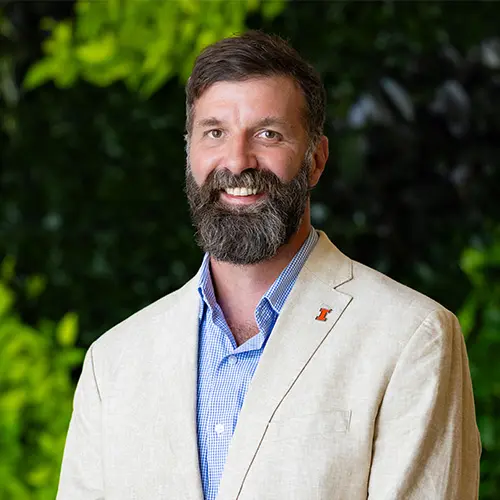
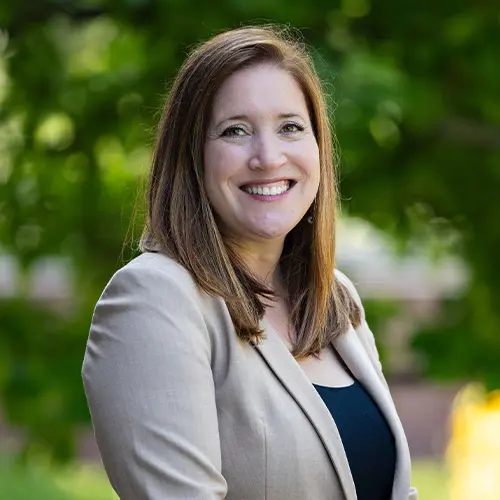 Professors Samantha Lindgren, Jon Hale and Jennifer Johnson lead a group of Education at Illinois sustainability education scholars with considerable expertise across environmental history, human rights, Indigenous knowledge systems, policy, and transformative pedagogies.
“The future is uncertain. We live in a world of accelerating change and education is one of the most powerful tools we have for making sense of these changes and choosing how we respond to future challenges,” says Lindgren. “Sustainability Education allows us to critically examine education’s role in these changes – from climate change to AI – and its responsibilities for safeguarding the integrity of the planet and the well-being of all people and species.”
“The Sustainability Education Certificate at Illinois is unique in its alignment with Illinois curriculum mandates, international guidelines, and the real urgency presented by climate change,” says Hale. “Public education is a critical part of the solution and now the College of Education has a response that will resonate with educators and PK-12 administrators across the state, the U.S., and the globe.”
 Students say the certificate has transformed the way they approach sustainability and education
The program enrolled a handful of students in spring semester 2026, including Logan Pender, who earned his Ed.M. this May. Pender completed the certificate and describes the experience as an invitation to move beyond viewing sustainability as a buzzword and instead engage with it as a complex systemic issue. He says the coursework challenged him to reflect on questions of power, access, and impact while examining how educational practices can either reinforce or disrupt inequities.
“The certificate has fundamentally reshaped how I approach sustainability and climate change education by grounding it in questions of governance, reciprocity, and accountability,” Pender says. “It pushed me beyond surface-level inclusion of sustainability themes and toward a deeper interrogation of the systems and structures that underpin educational practices.”
The program emphasizes the interconnected nature of environmental, social, cultural, and economic systems. Students explore diverse perspectives on sustainability, including Indigenous knowledge systems and Global South traditions, while developing practical strategies for fostering change in educational and community settings.
Another distinguishing feature of the program is its focus on sustainability as both a subject of study and a way of thinking. Through the coursework and applied projects, students learn how to address complex challenges by considering the relationships between people, communities, technologies, and natural systems.
 “This perspective is increasingly important,” says Carine Verschueren, EPOL postdoctoral research associate and program faculty member. “Emerging technologies such as artificial intelligence raise new questions about how innovation can support both human and planetary well-being. How do we ensure that technological advances remain guided by ethics, equity, and environmental responsibility? The program encourages participants to grapple with these questions and imagine futures in which people and the planet can thrive together.”
Bryan Lake, another Ed.M. graduate who completed the certificate, highlighted the program’s emphasis on Indigenous knowledge systems, land-based learning, and community-engaged pedagogies.
“Through my work toward this certificate, I have gotten to explore Indigenous knowledge systems and land-based pedagogy where land and water and other non-human life are embraced as teachers and partners,” Lake says. “There is so much knowledge that could inform better ways forward. We just need to connect more people, build a collective why, and model how.”
Lake says the certificate directly influenced his work with pre-service elementary teachers, encouraging future educators to think more deeply about how learning can connect to local environments and authentic community experiences. The program’s emphasis on equity, cultural responsiveness, and climate action helped him challenge students to envision more meaningful and place-based approaches to teaching.
“The courses in the Sustainability Education certificate invite us to take a global lens in reimagining education and building the futures that we want for ourselves and for those who will inherit the earth,” says Lindgren. “We ask how education can facilitate futures that are limitless, rooted in justice, and that not only support life on earth, but encourage it to flourish.”
Beyond individual classrooms, the program is designed to build a broader community of sustainability-minded leaders. Students in the certificate program engage with peers from diverse professional backgrounds, creating opportunities to learn from one another and develop networks that extend beyond the duration of the certificate.
The flexibility of the fully online format allows working professionals to pursue graduate-level study while continuing their careers. At the same time, applied learning opportunities ensure that students can immediately bring new ideas and practices into their workplaces and communities. As institutions and organizations increasingly seek leaders who can address sustainability challenges with creativity, cultural awareness, and systems thinking, the Sustainability Education Graduate Certificate is a pathway for professionals eager to make a difference.
Individuals are encouraged to apply by July 15, 2026, for the Fall 2026 program start. Visit the program webpage to learn more and apply.
Related News
Climate and Sustainability Literacy: Educating People for a Better Tomorrow
.webp?sfvrsn=3675635c_3)