Designing & Delivering STEM Outreach with I-Sci Explorers
by Cris Perez Molina, CSBS / Jun 11, 2026
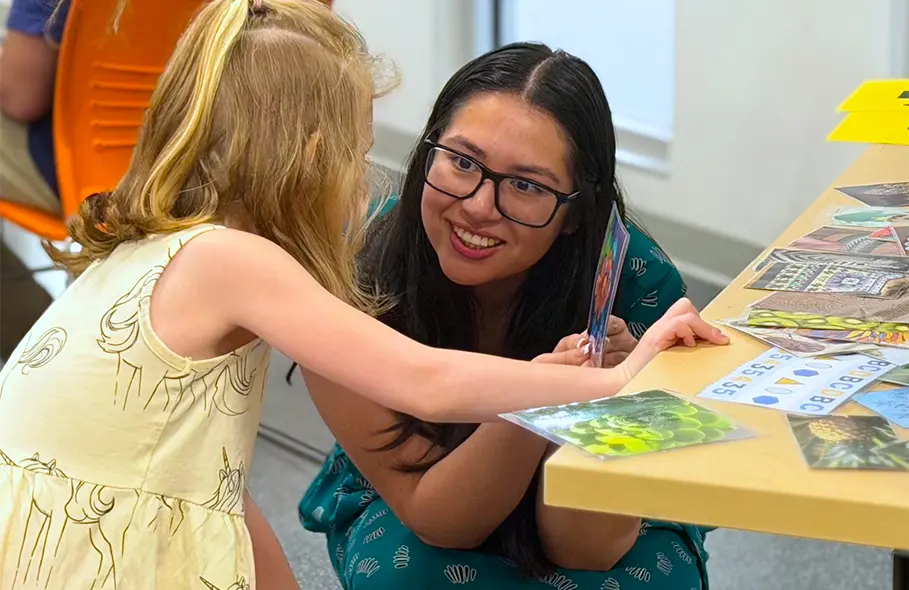
Graduate school trains researchers to communicate their work, but usually to other researchers. Conference presentations, departmental seminars, and academic publications are the primary outlets, and they share a common audience: people already familiar with the field and its jargon. The Designing & Delivering STEM Outreach workshop series, now in its second cohort since launching in Fall 2025, was designed to change that.
Run by the Illinois Science (I-Sci) Explorers, the workshop series gives graduate students the tools to take their research outside of the lab and into the community, translating complex scientific concepts into interactive, hands-on experiences for K-12 audiences. The goal is not just better science communications; it is building a habit of public engagement that participants can carry forward throughout their careers.
Building the Foundation
The series spans five sessions, beginning with a deep dive into outreach theory and practice. The first session brought together a range of voices from across campus: J.D. Graham from the National Center for Supercomputing Applications, Barbara Hug, teaching professor, Curriculum & Instruction, Lexie Kesler from the Beckman Institute for Advanced Science and Technology, Paige Duncan from the Illinois Science Explorers Program administered by the Center for Social & Behavioral Science, and Carolyn MacDonald, also from the Illinois Science Explorers Program. Each contributed their own hard-won lessons from working in STEM engagement, giving participants a well-rounded perspective on outreach and a practical foundation to build from.
After this initial session, students proposed activities rooted in their own research, then spent several sessions presenting and refining them, all while receiving feedback from outreach professionals and peers along the way. The iterative process pushed participants to think carefully not just about scientific accuracy, but about accessibility: what does this concept look like to a ten-year-old? What makes it fun?
The Real Test: Interacting with Youth
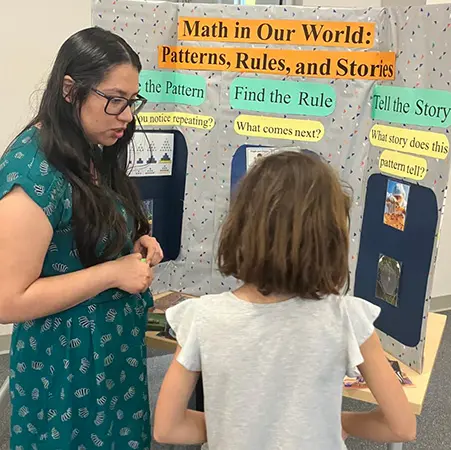
Perhaps the most formative moment of the workshop was when participants had the opportunity to pilot their activities at University Primary School. Designing an activity on paper is one thing; running it with a room full of kids is another. Participants quickly discovered that the language and framing that works in a slide deck does not always land with a young audience. They had to think on their feet, simplify on the fly, and find new ways to explain ideas when their first approach didn’t click.
That experience prepared participants for their final showcase: a Family STEM Night at the Martens Center, where they presented their polished activities to families from the broader community.
Beyond the Workshop
The impact of the series has not stayed contained to a single semester. Participants from the inaugural Fall 2025 cohort have returned to present at subsequent Family STEM Nights in the spring and Beckman Open House, a sign that the workshop does more than teach a skill set. It connects graduate students to a community of engagement they want to stay a part of. One participant, Anna Honeycutt, shared, “I just wanted to say thank you for providing this experience! I had a lot of fun and learned so much throughout the whole process.” Her reflection highlights the positive impact the workshop had on participants as they gained new skills, built confidence, and discovered excitement for STEM learning and community engagement. The program will head into its third cohort this fall, with applications opening later this summer.
This article was originally published by the Center for Social & Behavioral Science