Empowering Students in Math and in Life
by Tom Hanlon / Jun 10, 2026
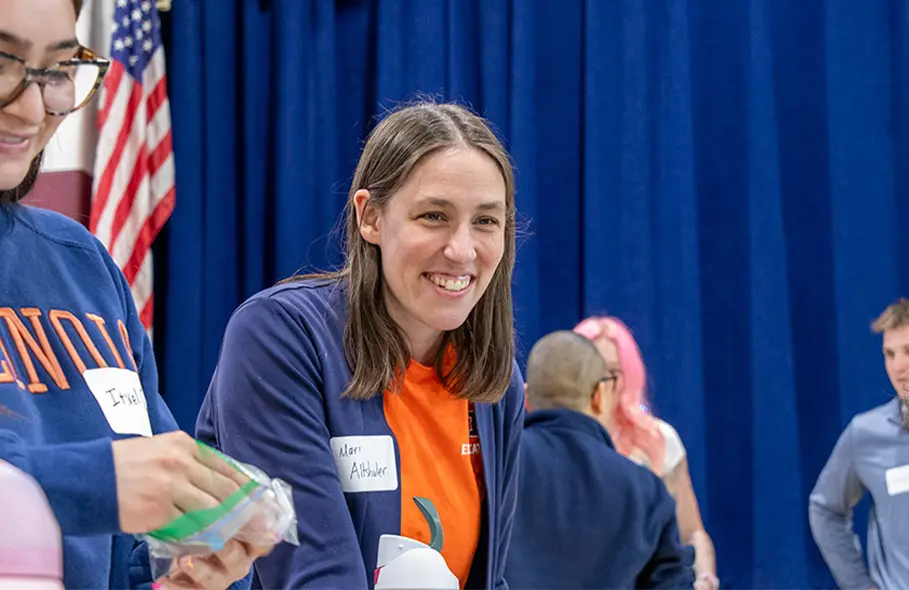
The College of Education’s partnership with an elementary school in Rantoul, Illinois, is helping young students and pre-service teachers develop a positive and empowered relationship with math.
Mari Altshuler first noticed it in the Chicago and Houston elementary schools that she taught in.
Math was polarizing. Some kids loved it. Others... Well, not so much.
And it wasn’t just the students. Teachers, too, were in separate camps on the subject.
“That’s what drew me back to graduate school,” says Altshuler, a teaching assistant professor in Curriculum & Instruction at the College of Education. “I saw that polarity as a source of intrigue. I wanted to understand why math is so polarizing and how we can prevent some of that polarization. We want 5- and 6- and 7-year-olds to feel the world is open to them, that they are capable learners in all sorts of domains.”
That same anxiety about math, Altshuler found, exists among pre-service elementary teachers (college students) too.
And thus, a partnership with an elementary school in Rantoul was born.
Getting Everyone Excited About Math
Altshuler has now been at the University of Illinois Urbana-Champaign for four years. She teaches two math courses each year for pre-service elementary teachers. In this role, she collaborates closely with her colleague, Adam Poetzel, a senior instructor in C&I, who also teaches these classes.
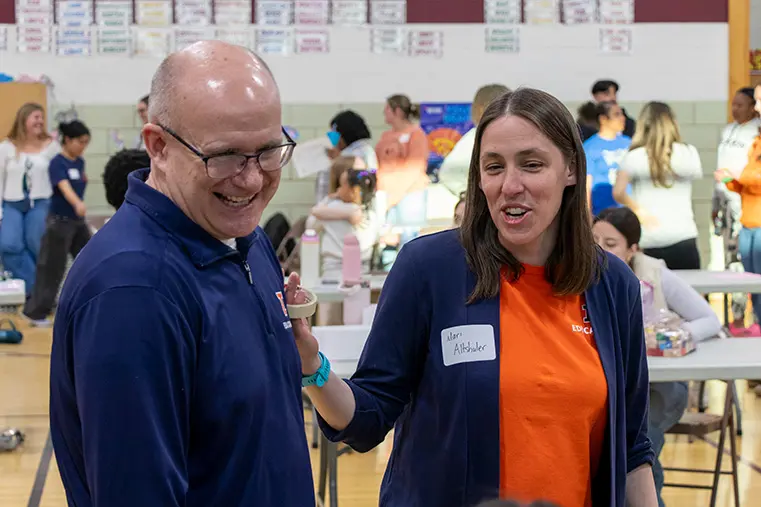
Altshuler’s research focus is centered on the belief that every child has the right to math experiences that lead to a positive, empowered relationship with the discipline. That relationship, of course, is driven by teachers.
“We want pre-service teachers to begin their careers being excited about teaching math, being confident in themselves mathematically, so they can pass on that positive energy to their young students,” Altshuler says. “We want them to pass on the message to their young students that math is reasonable, logical, and solvable, and that it’s not meant to be attainable only to a select few special people.”
Partnership with Northview and Broadmeadow Elementary
During the 2023-24 school year, Altshuler and Poetzel’s undergraduates in the College of Education developed materials for four different classrooms in four different rural school districts. But the pre-service teachers had no contact with elementary students and expressed a desire for that experience. In the 2024-25 academic year, Altshuler made that in-person connection happen at Northview Elementary in Rantoul, a K-5 school.
“We figured if we wanted our students to be able to apply their learning out in the world, to have real classroom experience connected to our course material, it had to grow from us,” Altshuler says. “So we made connecting with classrooms a part of the course.” Altshuler and Poetzel work with about 100 pre-service elementary teachers per year.
After the Rantoul school district reorganized its elementary schools, their collaboration continued during the 2025-26 year with Broadmeadow Elementary, a 3rd-5th grade school. Over the summer, the pair met with the school’s elementary teachers to envision what the partnership could look like. This past school year, they worked with 11 Broadmeadow teachers who each had about 20 students in their classrooms.
“We heard from the teachers about what they thought their strengths were and where they wanted support,” Altshuler says. “We also shared what we thought our pre-service teachers needed and how we thought we could make use of their expertise and their students to help. That’s how we launched programming this past year.”
Multi-Faceted Math Programming
During the 2025-26 year, Altshuler facilitated the implementation of four programs at Broadmeadow:
- Pen Pal Letters. “Our students wrote the elementary students two letters in fall and two in spring, telling about themselves as college students, what they’re interested in, and what they liked about math,” Altshuler explains. “The kids wrote back about how they felt about math and what they were learning about it.” The purpose, Altshuler says, was to build personal connections between the two groups and to give each group a lens into math learning from the other’s perspective.
- Math Talks. “In ‘Math Talks,’ a teacher poses a computational problem, and the students solve it and discuss the strategies as to how they got their answer,” Altshuler says. “The idea is to get students to see a wide range of problem-solving approaches and compare their strategies. Our pre-service teachers facilitated these activities.”
- Instructional Videos. Pairs of pre-service teachers have made 5- to 10-minute instructional videos on content that teachers identified as challenging for their students. “We made five videos last fall and five this spring,” Altshuler says. “Our students have found really creative ways to make the videos—for example, teaching about equivalent fractions in a pizza shop. And the Broadmeadow students are excited because they see their school in the videos.”
- Family Math Night. Over 100 undergraduates and 50 families showed up for this event. “It’s like our capstone of the year,” Altshuler says. “Pre-service teachers don’t get a lot of opportunities to work with families, so we created this event to give them that experience.” Families took part in 30 math activities across five content areas, with two or three undergrads facilitating each activity. “As the school has only 250 kids total, it was really exciting to have 50 families turn out,” she says.
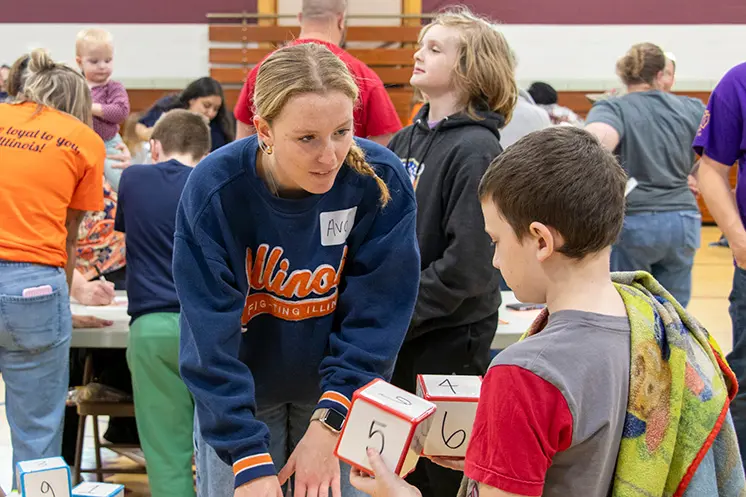
“My favorite part about the Family Math Night was getting to engage parents in this new realm of ‘gamified mathematics’ as opposed to ‘naked math’ with drill work and memorizing algorithms,” says Amelia Chasen, an Elementary Education major. “We had many comments from parents about this new kind of math and how they didn't understand why kids were breaking apart numbers instead of doing the classic up and down algorithm.”
“I really enjoyed being able to create an activity that could align with student interests,” says Jessica Gonzalez Silva, another Elementary Education student. “My group specifically created a Minecraft-aligned activity, which is something that a lot of students know or have heard of. Our activity sparked a lot of conversation regarding the game, and it was so much fun to use our imagination to work with the children.”
“We have had math nights in the past, but none of them were as successful as our most recent partnership with the U. of I.,” says Jackie Campbell, third grade teacher at Broadmeadow. “This experience went beyond just one event—it had a lasting impact on our students’ confidence and attitudes toward math.”
A Collaboration With Exponential Benefits
The partnership with Broadmeadow greatly benefits the pre-service teachers, Altshuler says.
“We’re gaining wonderful opportunities for our pre-service teachers to grow and learn,” she says. “You can talk in class all you want, but students’ learning deepens exponentially when they get to see some of these things play out with real children. The partnership brings to life what we talk about in the classroom.”
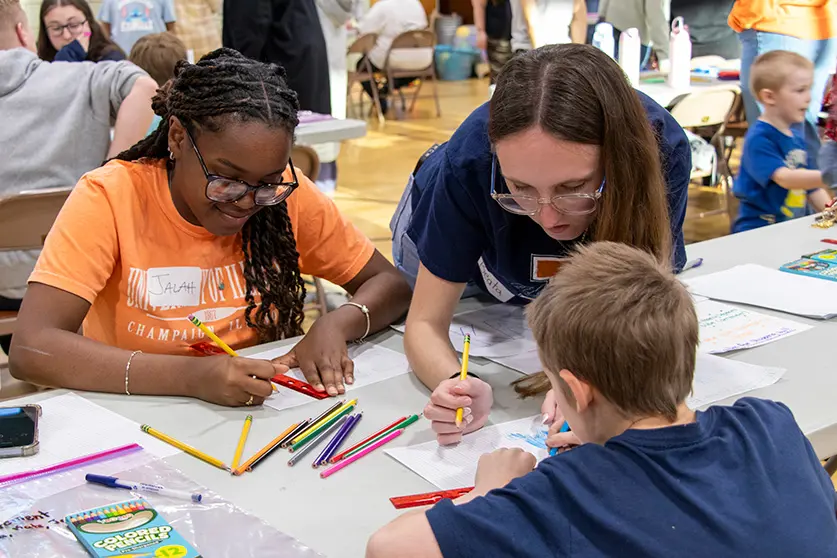
Altshuler notes that pre-service teachers often don’t come in enthused about math, “but when it’s paired with children who get excited by seeing them and about doing math with them, they see the joy that can be found in learning math, and they feel more enthusiastic themselves.”
The partnership also helps Broadmeadow achieve some of its pedagogical goals, Altshuler notes.
“The elementary students see math as a subject where they have these really cool college buddies,” she says. “They see math as this thing where there are extra people in the building with extra energy. It associates math with positive and exciting feelings.”
As for Broadmeadow teachers, Altshuler says, “I hope they feel like they have thought partners that they can bounce ideas off of, as well as extra hands in the classroom, which is no small thing.” She and Poetzel delivered materials and resources that the pre-service teachers developed for use in the elementary classrooms.
“The partnership with the University of Illinois has been a tremendous benefit for our students as well as our teachers! The students have really enjoyed having the small group instruction with the hands-on games,” says Collette Oprondek, Broadmeadow Elementary Assistant Principal.
“Overall, this collaboration has created a positive, engaging learning environment that fosters both academic growth and excitement for learning,” Campbell adds. “These interactions have also encouraged greater confidence, especially for students who are typically more reserved. They are more willing to take risks, ask questions, and try new strategies when working with the pre-service teachers.”
Building a Sustainable Partnership
Altshuler and Poetzel are working to build an ongoing partnership with Broadmeadow.
“We really are doing this with the intention of it being a multiyear, sustainable partnership,” she says. “We’re constantly innovating and iterating and communicating and making sure that our pre-service teachers continue to really benefit from the experience and so do the Broadmeadow students and staff.”
“The partnership is important because the university is such a wealth of resources for our school community,” says Oprondek.
“Overall, this partnership has been incredibly valuable for our classroom community,” says Campbell. “It has not only strengthened students’ academic skills, but also helped build their confidence, communication, and collaboration with others. Additionally, this experience has helped our students begin to see themselves as future college students. Having consistent, positive interactions with college students has made those goals feel more attainable and realistic.”
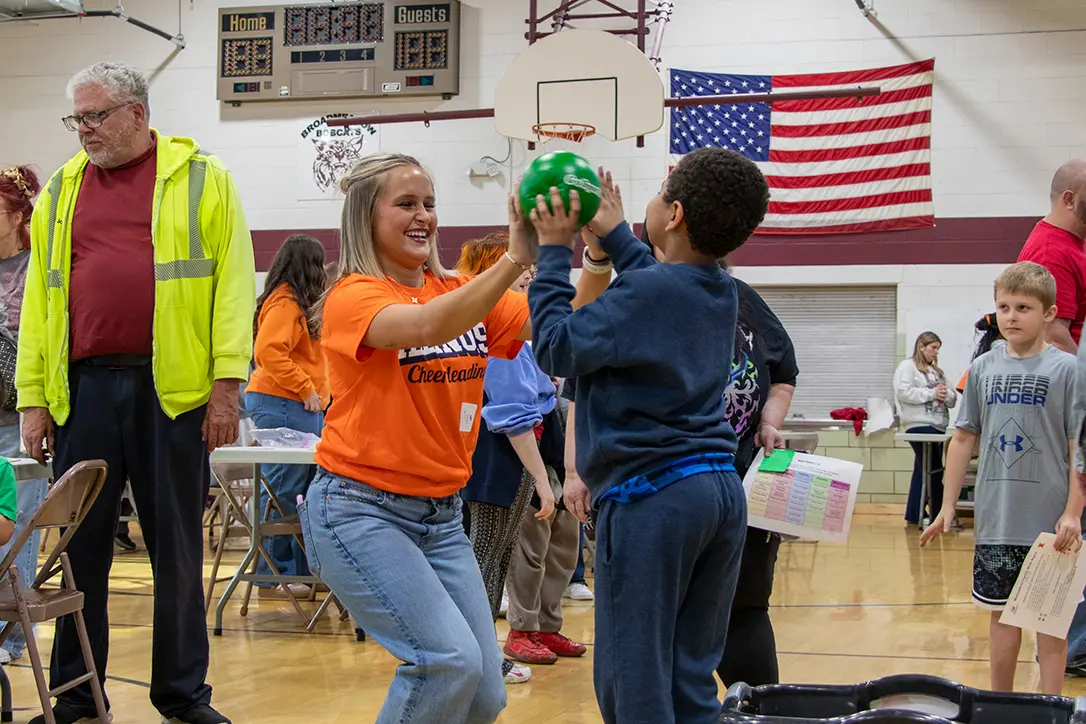
Altshuler wants students to see math as more than just solving a mathematical equation.
“Any kind of math content that challenges you to think differently is growing problem-solving skills that are applicable both within and outside of the domain of math,” she says. “Regardless of the specific math content, I want kids to see that being challenged to make new connections, notice patterns, and apply knowledge from a past experience to a current one are all important skills in math and throughout life.”