Organizational Citizenship Behavior: Strengthening Engineering Student Teamwork
by Tom Hanlon / May 27, 2026
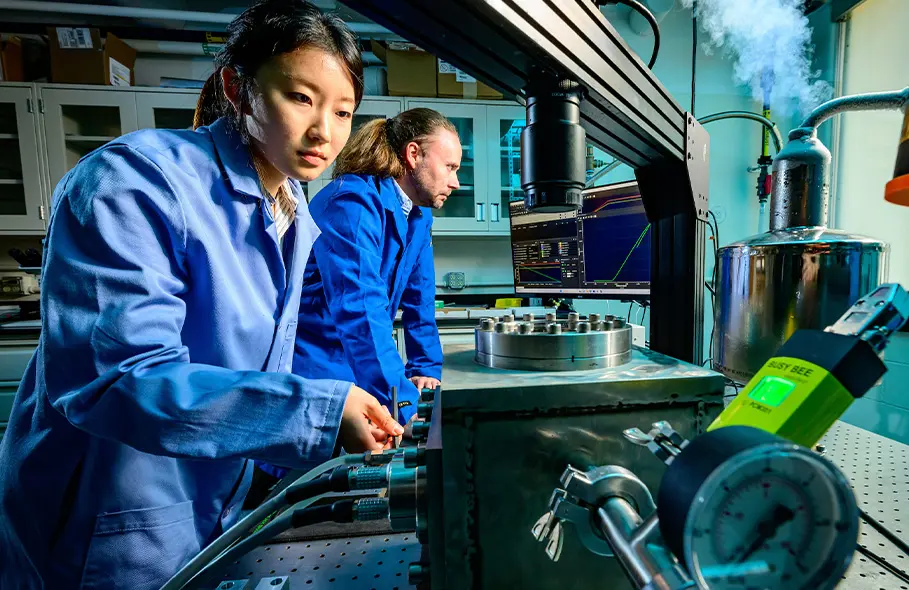
Education faculty member Eunjung Grace Oh is part of a cross-institutional research team working to create meaningful change in the collaboration process of mechanical engineering students.
Quick Take
- Mechanical engineering undergraduate students face many challenges in working cohesively and effectively in teams.
- Eunjung Grace Oh and colleagues are conducting a three-year study that kicked off in late 2025, involving implementing organizational citizenship behavior which emphasizes healthy team functioning.
- A primary goal is to create meaningful and actionable strategies that instructors can adopt to cultivate collaborative learning in engineering classrooms.
Mechanical engineering is difficult enough without the added challenges from inefficient teamwork.
That’s one of the issues that Eunjung Grace Oh and three colleagues from the University of New Mexico and the University of Georgia are tackling in a three-year study funded by the National Science Foundation. The program they are developing is called CEET—Collaborate, Elevate, and Engineer Together.
“The project began with a recurring concern we, as a cross-institutional research team, observed in engineering education,” says Oh, associate professor in Education Policy, Organization & Leadership at the College of Education. “While many programs emphasize team-based learning, student teams don’t always function effectively.”
Oh brings her expertise in human resource development and instructional design, particularly in facilitating collaborative learning and engagement, to the project.
“What we found particularly interesting was that these challenges often stem not from a lack of technical ability, but from breakdowns in team behaviors and interactions,” says S. Pil Kang, associate professor of Organization, Information and Learning Sciences at the University of New Mexico. Kang is the project’s principal investigator and has extensively studied organizational citizenship behavior, a key component of the program.
“Seemingly minor issues such as delays in sharing information, lack of communication about changes, or limited consideration for others can significantly disrupt team functioning,” Oh notes. “We also began to see that these issues are closely connected to the broader challenges students experience as they enter engineering. Many students feel isolated in team settings or struggle with collaboration in ways that negatively affect their overall learning experiences.”
Organizational Citizenship Behavior: Critical in Engineering
CEET is focusing on improving undergraduate mechanical engineering students’ learning and course engagement by introducing the idea of organizational citizenship behavior (OCB) in the classroom. OCB, Oh says, refers to voluntary actions that are not formally required but contribute to the effectiveness of a team.
“However, when we talk about ‘good’ OCB, there is often a misconception,” she notes. “It is sometimes interpreted as being more altruistic, doing more work, or having one person step up and carry the team. Our perspective is somewhat different from this view.
“We define good OCB not as an individual doing more, but as behaviors that allow a team to function reliably. This includes actions such as proactively sharing information, communicating changes in advance, or informally supporting teammates when they are struggling. These behaviors are often subtle and may go unnoticed, but they play a critical role in maintaining the flow of teamwork.”
OCB is critical in engineering, Oh says, because problems are complex and roles are often not clearly defined.
.webp?sfvrsn=70958d79_1 "EunjungOh (1)") “Many team challenges do not arise from a lack of ability, but from small breakdowns in communication, coordination, or shared awareness,” Oh explains. “Over time, these small actions accumulate and often determine whether a team succeeds or struggles. We aim to help students develop not only as contributors to a project, but also as effective members of a team, strengthening their sense of belonging and their identity as engineers.”
“Many team challenges do not arise from a lack of ability, but from small breakdowns in communication, coordination, or shared awareness,” Oh explains. “Over time, these small actions accumulate and often determine whether a team succeeds or struggles. We aim to help students develop not only as contributors to a project, but also as effective members of a team, strengthening their sense of belonging and their identity as engineers.”
Many engineering students, Oh notes, face significant challenges as they enter the classroom.
“They often struggle with self-doubt, including imposter syndrome, and move between anxiety and overconfidence as they try to navigate unfamiliar expectations,” she says. “In some cases, they feel isolated, and team-based learning can become a source of stress rather than support.
“Our goal is to help students experience this journey as a process of growth rather than struggle. While OCB supports collaboration at a functional level, our larger vision goes beyond that. By experiencing team environments where OCB is actively practiced, students can begin to see themselves as engineers, develop a sense of belonging within a learning community, and learn how to create synergy by connecting their strengths with others. We believe that these experiences help lay the foundation for creativity and innovation.”
Three Phases of CEET Study
OCB has been widely studied in organizational and workplace settings, Oh says, but it has not been systematically applied in engineering education. To that end, she and her colleagues are developing and implementing a series of pedagogical interventions grounded in OCB throughout the semester. The interventions are organized in three phases.
“The first phase, Collaborate, begins in Week 1,” Oh says. In this phase, students are introduced to collaboration and OCB in the course context, with a focus on understanding these concepts and beginning to build collaborative learning relationships.
“The second phase, Elevate, begins as students engage in teamwork for the final project. During this phase, students deepen both individual and collective growth by collaborating within and across groups through learning activities that support the experience and application of OCB.
“The final phase, Engineer Together, occurs toward the end of the semester. In this phase, students work toward accomplishing their team goals, engage in a collaborative learning community, and recognize and reflect on their peers’ contributions and demonstrations of OCB.”
The framework is being piloted in Mattias Pleil’s mechanical engineering classes at the University of New Mexico. Pleil is director of the Manufacturing Engineering Program at UNM.
“I want students to leave these courses with more than just a finished project,” Pleil says. “I want them to feel more confident in how they contribute to a team, how they communicate with others, and how they work through challenges together. Those experiences can make a real difference in helping students see themselves as engineers.”
At the end of Year 1 of the three-year project, the team will analyze the findings and refine the interventions as needed and continue to collect data across three additional iterations in Years 2 and 3. They will disseminate their findings and the CEET framework through conferences, peer-reviewed publications, open educational resources, and other means, Oh says.
Generating Actionable Strategies
“Our hopes are that this study offers a set of meaningful and actionable strategies that instructors can adopt to cultivate collaborative learning in engineering classrooms,” Oh says. “At a practical level, I aim for the project to enhance undergraduate students’ learning experiences in mechanical engineering by fostering a stronger sense of belonging, deeper engagement, and clearer engineering identity. I anticipate that the OCB-driven CEET interventions will help create a more supportive and collaborative learning environment in which students actively engage in knowledge sharing, reciprocal support, and collective problem solving. Through these efforts, I expect improvements in students’ academic performance, persistence, and overall satisfaction, particularly among those who may be at greater risk of disengagement.”
“The CEET project will generate actionable strategies for cultivating collaborative learning in engineering classrooms while advancing theory and practice by strengthening students’ belonging, learning engagement, engineering identity, and persistence through OCB-driven support and knowledge sharing,” says Caleb Seung-hyun Han, associate professor in the Department of Lifelong Education, Administration and Policy at the University of Georgia. Han contributes his expertise in human resource development and knowledge sharing, with a focus on how students prepare for their future roles as engineers. He leads the quantitative research components of the project, including data collection, validation testing, and network analysis.
Broadly Advancing Collaboration in Engineering Education
“For us, CEET is not just a single project, but a framework for rethinking how collaboration is understood and designed in engineering education,” Oh says. “Our goal is to develop a model that is scalable, adaptable, and sustainable across different courses and educational contexts. I view this CEET project as part of a broader effort to advance collaborative learning through the lens of OCB, while also bridging social capital theory and practice.”
“Overall, this work reflects my continued commitment to advancing research that is both theoretically grounded and practically impactful, especially in contexts where students’ professional knowledge and identities are still developing.”
Oh would consider the project a success if they observe a shift in how students approach teamwork, from focusing primarily on outcomes to giving equal attention to both outcomes and the process of collaboration.
“If they become more intentional about their behaviors within teams, such as proactively sharing information, communicating in a timely manner, and supporting one another while not depending on a single individual, that would represent a meaningful change,” she says.
“We also aim to see students move beyond simply task completion toward developing a sense of belonging within their teams and a stronger identity as engineers. Furthermore, if these experiences foster the building of trust and relationships among students, leading to the development of social capital that supports ongoing learning and collaboration, this would be a significant outcome.
“Finally, success would extend beyond a single project. If we are able to translate these ideas into practices that can be adopted across other courses and contexts, this would indicate meaningful broader impact.”