Educational Theory: 75 Years Young and Growing Stronger
by Tom Hanlon / Apr 20, 2026
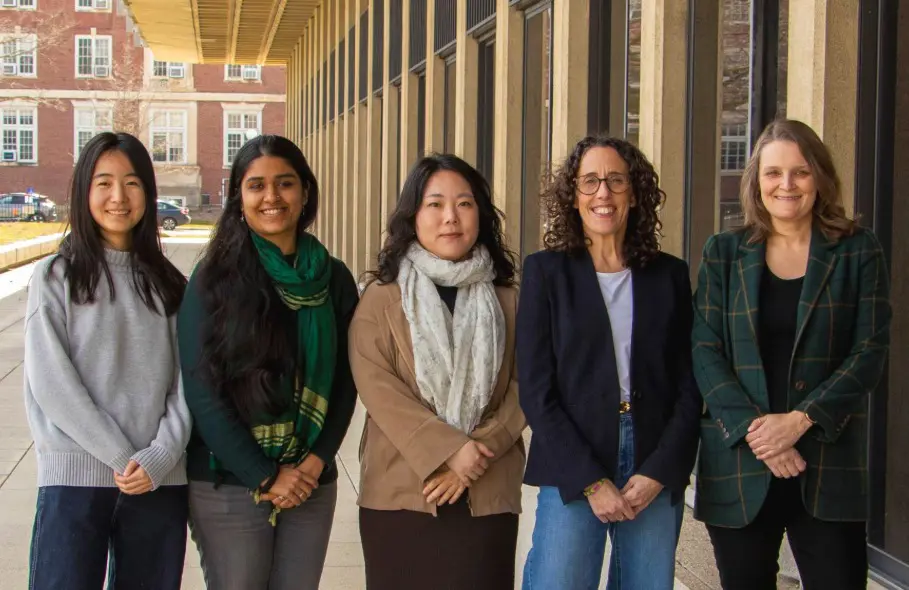
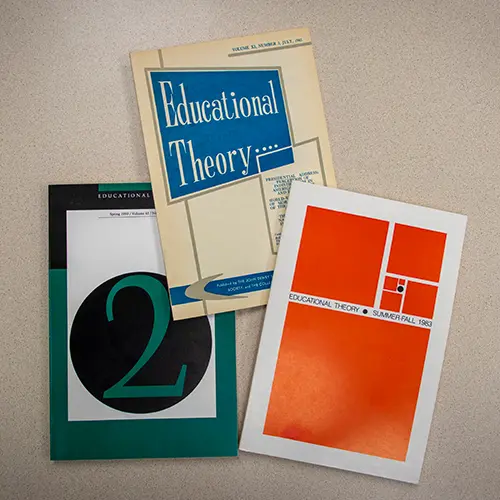
The journal Educational Theory celebrates a major milestone anniversary of providing a space for critical conversations in the field.
In 1951, Winston Churchill was re-elected UK Prime Minister, New York Yankees great Mickey Mantle hit his first home run, and the trial of Soviet spies Julius and Ethel Rosenberg began.
And Educational Theory, a journal created to stimulate discussion of educational concepts and aims among educators, was first published through the College of Education at the University of Illinois Urbana-Champaign.
The journal, celebrating its 75th anniversary this year, is the longest-running English-language journal in the field, says Rebecca M. Taylor.
“It’s a leading journal in the philosophy of education globally,” says Taylor, editor of the journal and associate professor in the Department of Education Policy, Organization & Leadership. “It provides an important space for foundational discussions about conceptual, philosophical, and theoretical work in education. The journal looks at understanding education and what purpose it should fulfill in contemporary society. We’ve been addressing those questions in a variety of ways over the years.”
New Territory
As it passes its 75-year mark, Educational Theory builds on its solid foundation while exploring new territory.
Part of that new territory is in the journal’s leadership. Taylor, who took over as editor in 2024, is its first female editor. And she leads the first-ever all-female staff.
“It’s quite humbling to helm the journal,” she says. “I’m grateful for the opportunity to lead the journal at this point in its history. It’s exciting to be at a point where it’s possible to have an all-woman team running a journal. We didn’t go out seeking an all-woman team, but that’s just how it came together.”
Taylor’s team includes managing editor Robin Maier and graduate students Soomin Nam, Ini Periodi, and Yunzhe Zhu, who serve as editorial assistants.
Old Topics, New Relevance
Taylor says that many of the articles in the 75th-anniversary issue, published in January 2026, addressed themes first explored in 1951.
“Many themes that were relevant back then are still relevant today, such as academic freedom,” she notes. “Many topics of discussion remain the same, though they are relevant in new ways today.”
For example, foundational questions such as the purposes of education in a democratic society, the role of autonomy and human flourishing in education, and the nature of teaching, learning, and knowing are perennial topics that continue to be meaningful today, Taylor says.
“We also continue to explore the tensions between socialization and transformation or liberation, authority and expertise in the student-teacher relationship and how it informs the learning process, and understanding teaching as an ethical and relational practice,” she says. “Another big area is around ethics, exploring the values that should guide education, the types of values and morals that should be taught in schools, as well as what ethical standards schools and educators should be held to.”
In addition, Educational Theory studies the relationship between education and democracy and looks at how varieties of injustice arise in education, as well as the responsibilities educators and schools have to remedy those injustices, Taylor notes.
“We examine how these kinds of foundational issues should inform questions about specific educational policies,” she says. “We see a lot of work coming through the journal where scholars are looking at particular policies and applying one of these foundational lenses in examining them.”
More Recent Explorations
Interdisciplinary work, globalization and comparative educational philosophy, and equity and justice are newer issues explored by the journal, Taylor says.
“There’s a lot more empirical research and practice going on in the field now, a lot more interdisciplinary work,” she says. “We’re looking to support more interdisciplinary collaborations between philosophers of education and education researchers. This was happening before, but we’re amplifying that.”
In addition, Taylor says, the journal is looking at concepts such as “epistemic injustice, how people can encounter injustices in their capacities as learners, how social, economic, political, and other kinds of injustices exist, such as environmental and intergenerational injustices. These types of issues have come up more in the past couple of decades.”
Even more recent is the topic of AI in education.
“Technology and AI in education are a growing focus in our field,” Taylor says. “In the submissions coming in, we see a lot of interest in understanding it better. There are many practical questions around AI, a lot of ethical questions arising around AI, and how it changes how we understand teaching and learning, and some of those foundational questions.”
Podcast Partnership
Another new wrinkle for this venerable journal is its partnership with the podcast Thinking in the Midst, hosted by Cara Furman, an associate professor of early childhood education at Hunter College (NYC). On the podcast, philosophers of education talk about how their research can inform educational policy and teacher practice around current issues in the field. The podcast is sponsored by the Philosophy of Education Society.
“We partnered with the podcast starting with our seventy-fifth-anniversary issue,” Taylor says. “So far, they have produced three episodes featuring authors from that issue.” The partnership will continue, most likely with one episode per future issue (the journal is published six times a year).
“The plan is to have it be a regular partnership moving forward,” she says.
Expanding Readership and Authorship
Nearly 5,000 institutions across every continent have access to Educational Theory through Wiley, one of the leading academic publishers in the world.
“About half our articles last year were published open access, making them freely available to all readers globally,” Taylor says. “Our readership has increased steadily over the last four years.”
Readers, she notes, are spread around the globe, with the largest percent (29%) being from the U.S. Half of its authors are from foreign countries. Submissions tripled from 2023 to 2025.
“Educational Theory has positioned the University of Illinois as a really important cornerstone in the field of the philosophy of education,” Taylor notes. “It reflects Illinois’ leadership role in the philosophy of education nationally and globally. The journal has always been housed at Illinois, edited by University of Illinois faculty, and it helps us support graduate students who work for the journal. It has helped us maintain a strong program within the philosophy of education.”
She notes that many graduates of the program have gone on to edit other journals in the field. “They’ve come out of our program with this editing experience and have become leaders in the field,” Taylor says.
Global Expansion
Taylor sees global expansion in the future. “We already have global participation, with half of our authors and a little more than 70% of readers being outside the U.S., but we want to expand that even more,” she says. With that in mind, she has broadened the journal’s associate editor board to include representatives from more regions around the world.
Educational Theory has a long legacy of being responsive to the issues and changes in the field.
“I’m proud to be part of that legacy,” Taylor says. “We will continue to provide a space for these continuing conversations, the perennial issues that we’ve been talking about, far into the future.”