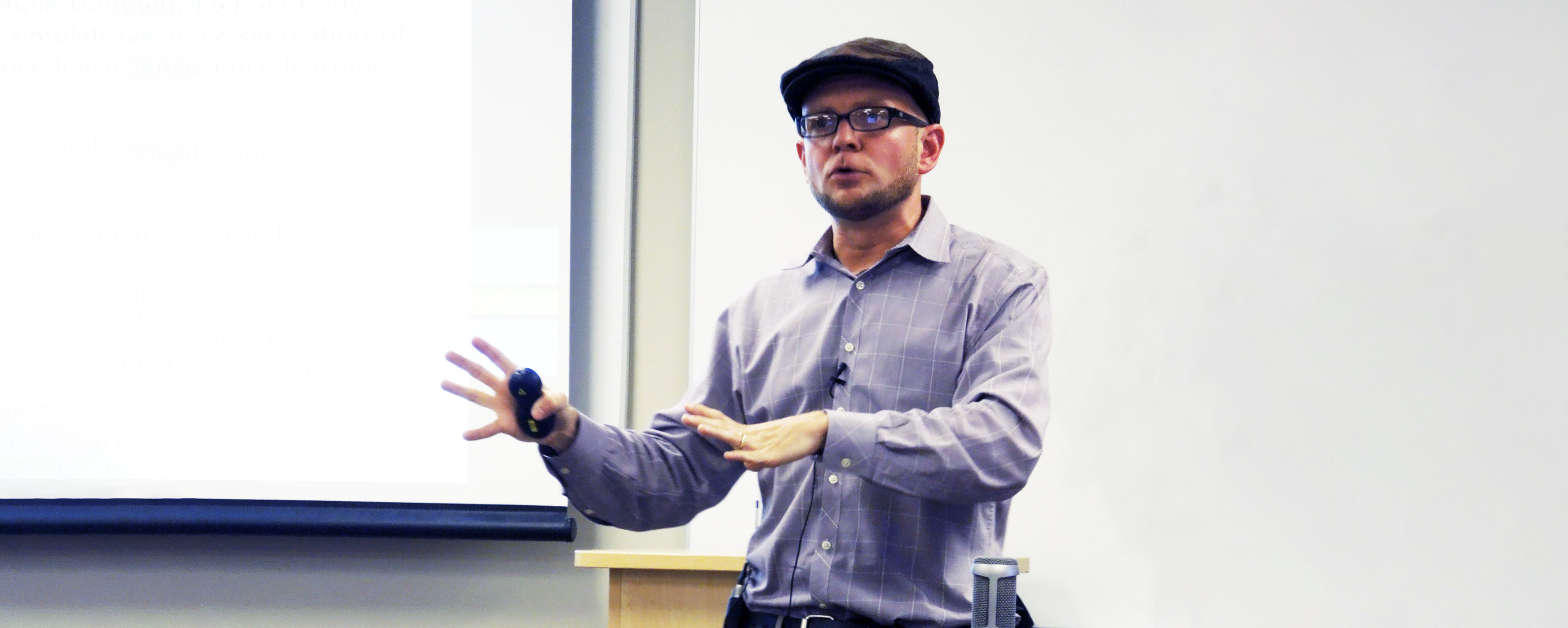
I'm a professor of Library and Information Science, Curriculum & Instruction, Bioengineering, Writing Studies, and the Center for East Asian & Pacific Studies.
My central interest is in learning—the constructive process whereby individuals and organizations develop as they adapt to new circumstances. This work draws on ideas such as John Dewey's theory of inquiry as well as on action research and situated studies. Much of it has focused on changes in the nature of knowledge, community, and literacy, as discussed in my new book, Literacy in the information age: Inquiries into meaning making with new technologies and other recent writing.
In my current research projects I see three major areas of investigation: new literacies, collective practice, and inquiry-based learning.
New literacies. A major part of this work has been to examine the relations among new technologies and trends in areas of language, education, work, democracy, and globalization, and to explore the new literacies. This is represented in papers such as "Credibility of the web: Why we need dialectical readin," "Literacy technologies: What stance should we take?," and other publications.
Collective practice. Another important focus has been situated studies of collective practice, as for example, with the Distributed Knowledge Research Collaborative studying new forms of writing and other collaborative practices in scientific research. Other studies include research on Biology Student Workbench (a computational environment that facilitates bioinformatics research, teaching, and learning), Plants, Pathogens, & People, Physics Outreach, and SEARCH. This work is represented in books including Network-based classrooms: Promises and realities (Bruce, Peyton, & Batson, 1993) and Electronic Quills: A situated evaluation of using computers for writing in classrooms (Bruce & Rubin, 1993).
Inquiry-based learning. My research has also contributed to the development of environments for inquiry-based learning. These include the Inquiry Page, which is a website, a set of communities, and a research project on inquiry; Biology Student Workbench, an interactive resource to support investigations in molecular biology and evolution; Chickscope, a project in which students engage with a community of inquiry as they use remote instrumentation study chicken embryology; Quill, tools and environments to support literacy learning; Statistics Workshop, an interactive system for learning statistical reasoning; and Discoveries, a series of CD-ROM-based multimedia environments for supporting students' inquiries in science and social studies.
Current goals. My current goals include (1) developing a pragmatic technology analysis of collaboration, (2) completing a study of community inquiry laboratories, and (3) fostering the establishment of community inquiry laboratories in diverse settings.
Teaching. I teach in masters and doctoral programs in Library and Information Science and Writing Studies and in the undergraduate minor in Information Technology Studies, specifically the capstone course, Literacy in the Information Age). I also conduct workshops on inquiry learning and new technologies with teachers, librarians, museum educators, and community groups.
Awards. I received the Council of Graduate Students Faculty Award for Excellence in Graduate Teaching, Advising, and Research in the College of Education and have regularly been selected for the University's "Incomplete List of Teachers Ranked as Excellent." I received the College of Education Senior Scholar Award, the Faculty Fellows Award, and am a Fellow of the National Conference on Research in Language and Literacy. I serve on the editorial boards of Educational Theory, Computers and Composition, Discourse Processes, Computer, International Journal of Educational Technology, and Interactive Learning Environments, and on many advisory boards including those for the Center for Writing Studies, the Mathematics, Science, & Technology Education Office, the NCSA's Education, Outreach, & Training, the University's Arts in a Technology-Intensive World, and the Council of Education's K-12 School Media Area.